
IoT Sensor Battery Life: A Duty-Cycle Test Method
By PlainBattery Team
Key takeaways
- Model one complete successful reporting cycle.
- Include retry behavior and regulator quiescent current.
- Test pulse sag near end of life and at the coldest expected temperature.
An IoT sensor can sleep at a few microamps and still empty its battery early. Radio retries, sensor warm-up, an indicator LED, regulator quiescent current, and cold-temperature voltage sag often matter more than the advertised sleep current.
Define one reporting cycle
List every state between two successful reports. Include boot, sensor stabilization, conversion, processing, transmit, receive window, flash writes, and network retries.
| State | Example current | Duration | Events per hour |
|---|---|---|---|
| Deep sleep | 8 µA | remainder | continuous |
| Sensor warm-up | 4 mA | 200 ms | 12 |
| Processing | 2 mA | 40 ms | 12 |
| Radio transmit | 16 mA | 8 ms | 12 plus retries |
| Receive window | 6 mA | 50 ms | 12 |
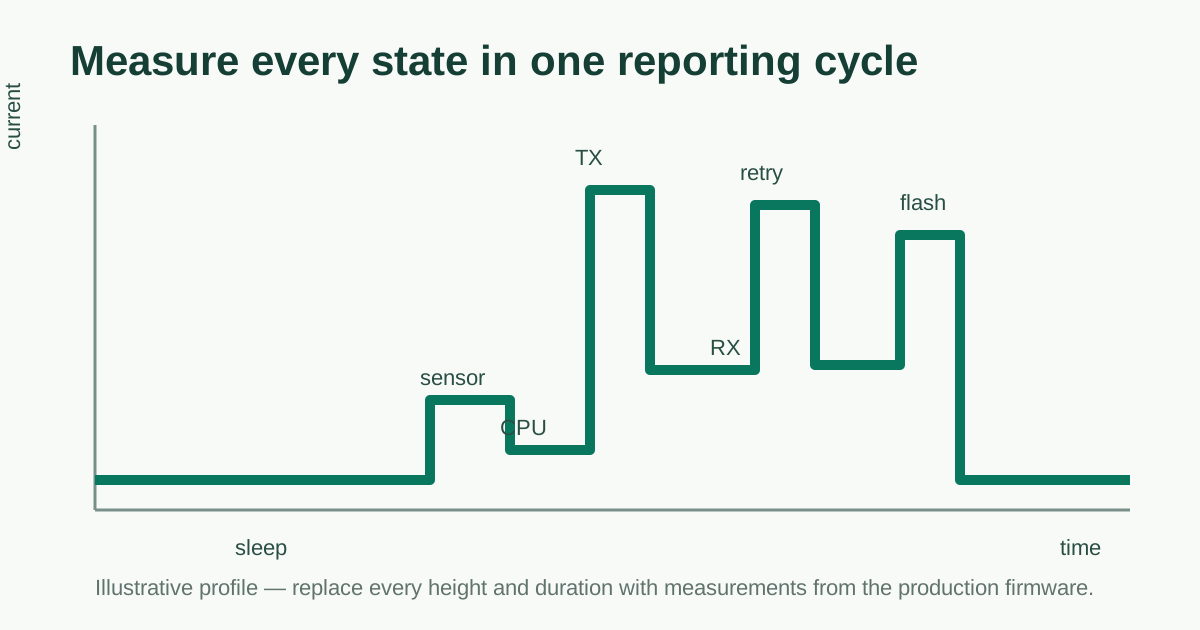
The diagram is a modeled shape, not a captured result. Replace its relative heights and durations with production-firmware measurements.
Measure retry frequency under realistic signal conditions. A gateway one metre from the bench can hide the cost of a weak production link.
Run three measurements
Use a current profiler, power analyzer, or a calibrated shunt and oscilloscope. The Nordic PPK2 guide documents one suitable current-profile workflow. Disconnect development-board USB and debugger circuits.
- Capture a clean report with a successful first transmission.
- Capture a poor-link report with retries.
- Capture startup, pairing, and a representative firmware-update operation.
Copy the states into the runtime measurement worksheet, including retry count and the network conditions used for each capture.
Integrate current over time to get charge per event. Peak current alone exaggerates usage; sleep current alone ignores it.
The following is a modeled calculation, not a PlainBattery bench result. Assume a profile averages 42 µA, then add 3 µA regulator quiescent current and 2 µA of leakage. Total average current is 47 µA, or 0.047 mA. A nominal 235 mAh CR2032 gives:
Ideal life = 235 ÷ 0.047 = 5,000 hours = 208 days
Planning life at 70% usable capacity = 164.5 ÷ 0.047 = 146 days
The usable fraction represents cutoff voltage, temperature, storage age, and pulse sag. Replace it with test data for a released product.
Test end-of-life voltage sag
Internal resistance rises as a coin cell discharges. The same transmit pulse therefore creates a larger voltage drop late in life. Record minimum voltage during radio activity, the MCU brownout threshold, bulk capacitance, and recovery time.
You can emulate an aged source with a controlled supply and series resistance, then repeat at the product’s lowest expected temperature. A capacitor can support a short pulse; it cannot correct a high average load or continuous retries.
The Energizer CR2032 data sheet separates its light continuous-capacity test from a pulse test. That distinction is why nominal capacity alone does not predict radio service life.
Choose the cell after measuring
- CR2032: compact and suitable for low average current with controlled pulses.
- CR2450: more capacity and volume when a 24.5 × 5.0 mm holder fits.
- AA primary or NiMH: better for sustained current, displays, or actuators.
- Lithium-ion: requires protection, charge control, and electronics designed for its voltage range.
Compare CR2032 and CR2450 and use the IoT application guide for device-level selection.
Preserve the evidence
Save the current trace, firmware version, reporting interval, network conditions, supply voltage, temperature, battery datasheet, and usable-capacity assumption. Repeat after firmware or radio-stack changes, then test several complete units until the actual cutoff condition occurs.
The general calculation, regulator treatment, and documentation checklist are in Battery Runtime: Measure Current and Use mAh Correctly.
Related charts
Review record and primary sources
Reviewed by PlainBattery Technical Review Desk on 2026-09-11. Checked: instructions and calculations, battery specifications used in examples, safety limits and linked primary references.
- Power Profiler Kit II User Guide — Nordic Semiconductor. Real-time current measurement, measurement ranges and accumulated charge.
- Energizer CR2032 Product Datasheet — Energizer Brands, CR2032EU0118 (2018). Rated capacity conditions, background drain and pulse-discharge characteristics.
Revision record: source citations and field-level review scope added September 11, 2026. See our sources and methodology and corrections policy.